The High Energy Physics group of the Aristotle University of Thessaloniki (AUTH) develops advanced computational methods for the analysis of experimental data from particle and nuclear physics experiments. The research activity combines high-energy physics data analysis, scientific software development, machine learning, and distributed computing, providing the computational tools required to process, reconstruct, analyse, and interpret large volumes of experimental data.
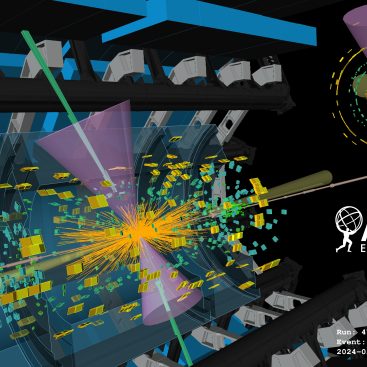
A major focus is the analysis of data collected by the ATLAS experiment at the Large Hadron Collider (LHC) at CERN). The group develops analysis methods and software for a broad range of physics studies, including Higgs boson, diboson, and Vector Boson Scattering measurements, as well as searches for new physics. Computational methods are also applied to data from detector-development and instrumentation projects, including Micromegas and PICOSEC detector studies, where dedicated analysis and reconstruction software is developed for detector characterization and performance evaluation.
The group has expertise in the development of scientific software and data-processing pipelines, covering event reconstruction, detector calibration, data selection, statistical analysis, simulation, and visualization. Software development is closely integrated with experimental activities, enabling efficient processing and interpretation of data from both large-scale collider experiments and dedicated detector-development projects.
Machine Learning and Artificial Intelligence methods are investigated and applied to particle-physics data analysis, including classification, regression, pattern recognition, event reconstruction, and optimization of analysis strategies. These techniques provide powerful tools for extracting physics information from complex, high-dimensional datasets and for improving the performance and efficiency of experimental analyses. The group’s research includes the development and application of machine-learning algorithms specifically for the analysis of ATLAS experimental data.
The computational infrastructure supporting these activities includes GRID and distributed computing technologies, which enable the large-scale processing, distribution, and storage of experimental data. The group has developed GRID computing infrastructure for ATLAS data analysis, while the computational resources of the AUTH, including the Aristoteli computing cluster, provide additional capabilities for data-intensive analysis, simulation, software development, and machine-learning applications. The integration of distributed computing with modern data-analysis techniques enables the group to address the computational demands of contemporary particle-physics experiments.